
Pennsylvania Shows Where the Abortion Movement Is Headed
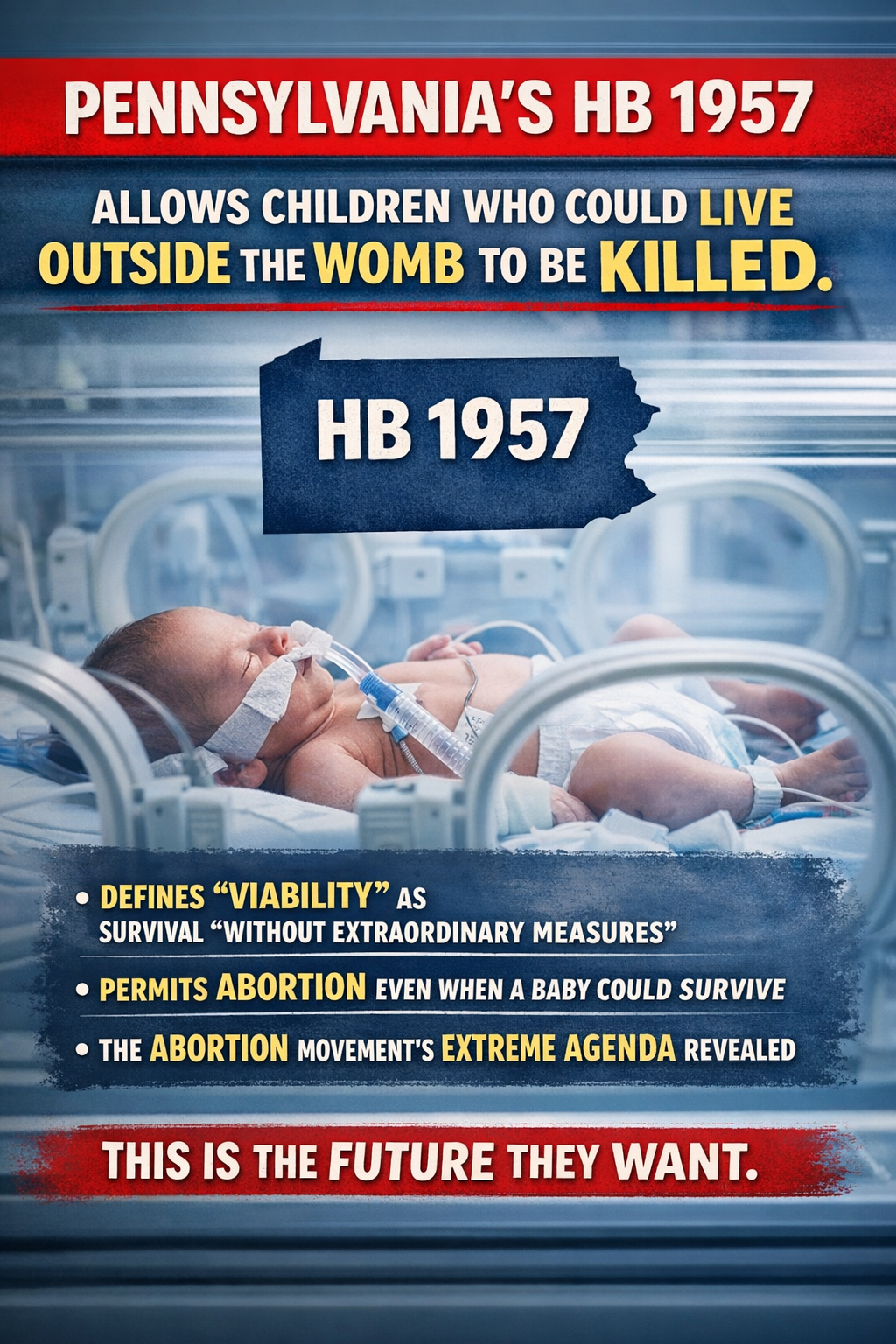
For years, the abortion lobby has hidden behind vague language. Words like “viability,” “health,” and “reproductive liberty” were used to reassure the public that there were limits, that no one was talking about abortion late in pregnancy, and that extreme outcomes were just scare tactics from pro-lifers.
Pennsylvania just pulled back the curtain.
House Bill 1957 proposes a constitutional amendment creating a so-called “fundamental right” to abortion. But the most revealing part of the bill is not that it expands abortion. It is how clearly it defines when a child’s life may be ended.
The bill allows the state to regulate abortion after fetal viability, but then immediately strips that authority away by declaring that abortion may never be prohibited if a health care professional claims it is medically indicated for the woman’s physical or mental health. That alone is broad enough to swallow any meaningful limit. But the real shift is how Pennsylvania defines viability.
Viability is no longer treated as a moral or biological threshold worth protecting. Instead, the bill defines it as a point at which a child has a “significant likelihood” of surviving outside the womb without extraordinary medical measures. In plain language, the bill explicitly acknowledges that a child could be capable of living outside the womb and still be legally killed.
This is not an accident. This is not sloppy drafting. This is the abortion movement saying the quiet part out loud.
Missouri saw this playbook in 2024. Amendment 3 deliberately blurred the meaning of viability so that it could be stretched to justify abortion on demand at any stage of pregnancy. Pennsylvania has gone a step further. Rather than pretending viability offers real protection, this bill openly states that even a child who could live outside the womb has no guaranteed right to life.
That is a new step. And it is revealing.
For decades, Americans were told that late-term abortions were rare, tragic, and heavily restricted. Then we were told that viability was the safeguard. Now, we are being told that even viability is not enough. The child’s ability to live is no longer the standard. The standard is whether someone else believes that child’s life is inconvenient.
This is the direction the pro-abortion movement has always wanted to go.
It was never about rare cases. It was never about compromise. It was never about balance. It has always been about removing every meaningful limit between a child and the abortion industry. First the laws fell. Then the language fell. Now even the basic idea that a viable child deserves protection is being discarded.
Missouri has a choice in 2026.
We can follow Pennsylvania down this road, where the law openly accepts the killing of children who could live outside the womb. Or we can restore a culture of life by passing Amendment 3, rejecting the extremism of the abortion industry, and reestablishing the ability of our legislature to protect unborn children.
What is happening in Pennsylvania is not an outlier. It is a warning.
And Missouri still has time to choose a different path.